
A Love Letter to Beavers
Updated: Apr 10
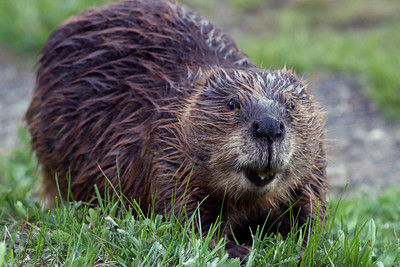
Ah, the magical beaver. They are fuzzy. Their semiaquatic tails are silly. There are hundreds of videos online of them happily munching on carrots and pumpkins, and every single one is a gift. They have even gotten our friends at WaterHub to use the term for beaver fans – Beaver Believers.
But what's truly remarkable about beavers isn't their charm — it's what they build.
If you work in water, civil, or environmental engineering, chances are you already know why beavers are cool. But for those who don't: beavers are ecosystem engineers. Fun fact: the beaver is the mascot of MIT, because of course it is.
Beavers slowly chomp through trees, fell them, and carry them to wherever they've decided a dam needs to exist. In doing so, they slow water, spread it across landscapes, and create wetland complexes where there may have been none before.
They're not waiting for a government tender or a feasibility study. They just get to work.
We talk constantly in the water world about nature-based solutions. But sometimes the most honest version of that means stepping back and letting nature do what it's built to do.
This World Water Day, we would like to honor the beavers with an appreciation post. This blog is going to share a bit about beavers for the uninitiated, and mention some fun examples of where beavers working on restoration have benefited projects in ways we couldn’t have done alone.
A hard history
But first, some context.
Beaver populations in North America once numbered in the hundreds of millions - some estimates as high as 400 million. European colonization, followed by the fur trade and widespread trapping, reduced that number to somewhere between 10 and 15 million today. Some even estimate it to be lower than that!
Once beavers disappeared, the landscapes changed. Areas that had once been wetland-rich, biodiverse, and hydrologically complex became drier, less diverse, and more vulnerable.
We didn't fully understand what we'd lost until long after the damage was done.
What happens when beavers work

Beaver families look at their territory and build dams where they see fit. When a beaver dam goes in, water slows down and spreads out. What follows is a cascade of benefits: water is retained, creating ponds, pools, and wetlands; flooding during heavy rains is mitigated; sediments and pollutants are trapped, improving downstream water quality; and biodiversity increases. Where beavers go, other animals, plants, and flora tend to show up soon after.
And there's a widely-held misconception worth addressing: beaver dams don't block salmon. They actually slow water, creating wider channels and deeper pools that give salmon places to hide from predators and find cooler refuge in warm conditions.
One of the more surprising findings comes from wildfire research. In Idaho, beavers were parachuted — yes, literally parachuted — into the Sawtooth Mountain Range in 1948 when they needed to be relocated away from growing rural communities. Later, in 2018, a wildfire moved through the region; the areas where the beavers had been at work for decades were largely untouched. Similar observations have been made in Canada: beaver ponds tend to remain green islands amid fire-scorched landscapes.
In the Czech Republic, local authorities were preparing to spend approximately EUR 1.2 million building dams in a protected landscape area. While they were still in the planning phase, the beavers had already done the work themselves — saving the government millions and significant time.
Beavers vs. human engineers
There's an instructive contrast between how beavers build and how humans build. Human dams are fixed. They silt over time, eventually lose their water-holding capacity, and have to be decommissioned. Beaver dams are flexible. Beavers move around, adjust, and continually rebuild where they think it makes most sense. They're not designing for permanence — they're designing for the ecosystem.
Beavers also develop canal systems to transport food and materials through their territories, thereby facilitating the movement of various plant species across landscapes.
Working with beavers

Beaver-based restoration isn't a silver bullet. Beavers aren't well-suited to every environment. Farmers don’t always appreciate them flooding their crops, and land owners may not want them gnawing through their landscaped lawns. Additionally, attempts to introduce them to arid desert landscapes, like parts of Utah, haven't always gone to plan. Context matters.
There's growing work, especially on the western coast of the US and in Canada, to identify where beaver reintroduction makes the most ecological and hydrological sense — particularly in areas where groundwater and surface water storage have become critical given increasingly unreliable water supplies.
In some cases, when the conditions aren't quite right for beavers, people are building hand-constructed "beaver dam analogues" to mimic their work and encourage beavers to settle in.
The shift happening now is one of perception. For a long time, beavers were hunted, displaced, and treated as nuisances. Now, more and more, we're looking towards indigenous knowledge to learn to work with them — to respect their instinct, their craft, and their role as some of the most effective water restoration workers on the planet.
It just took us a few centuries to catch up.
PS: If you would like a fun movie to watch, we recommend the 2026 movie Hoppers by Pixar. Environmentalists are loving it.


