
Built to Wait: Tardigrades Know About Drought

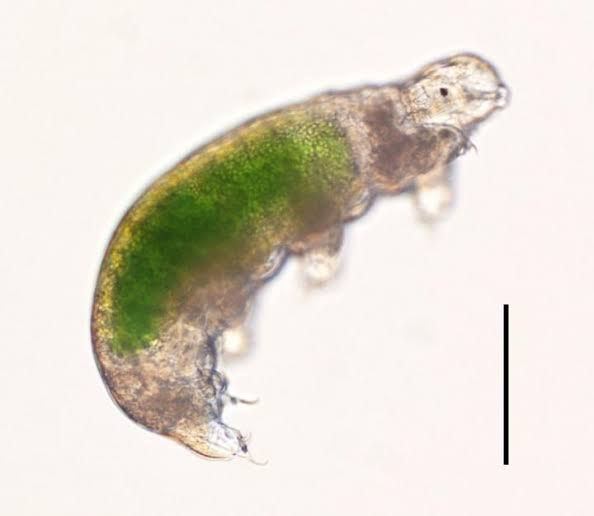
Squeeze a clump of moss from a garden wall into a dish of water, put a drop under a microscope, and there is a good chance something is looking back at you: eight stubby legs, a rounded body, called a tardigrade, also known as a "water bear" or "moss piglet,". Water and wastewater operators love them, and many have water bears tatted on their bodies as symbols of the water work they're passionate about.

This blog will share why a creature the size of a grain of sand has become one of the most studied organisms in extremophile research.
An Introduction to tardigrades
Tardigrades were first described in 1773 by Johann August Ephraim Goeze, a German zoologist who spotted them under a microscope and thought their lumbering walk resembled a bear's, hence their nickname of little water bear. They are everywhere once you know where to look. They are microscopic invertebrates, usually well under a millimeter long.
They have no lungs, gills, or circulatory system, so oxygen passes straight through their skin, which only occurs when their skin stays wet. Depending on the species, tardigrades act as herbivores, microbivores, omnivores, or predators, grazing on algae and moss cells, feeding on bacteria and fungi, or hunting smaller invertebrates, while larger soil- and moss-dwelling animals also prey on them. This helps move nutrients through moss and soil ecosystems by breaking down microorganisms and releasing nutrients back into the system.
Tardigrades need a thin film of water around them to stay active. Without that water, most animals would simply dry out and die. However, when tardigrades’ environment dries up, they pull in their limbs, expel almost all the water from their bodies, and curl into a dehydrated state called a "tun." This is called cryptobiosis, and in tardigrades it typically means losing more than 95 percent of their body's water. Add water back, even years later, and they rehydrate, unfurl, and carry on.
The current record for a rehydrated tardigrade coming back from that state belongs to a moss sample collected in Antarctica in 1983 and frozen at -20°C for just over 30 years. When researchers thawed it in 2014, two individuals and an egg revived, and one tardigrade went on to reproduce.
Is it safe to drink them, and what happens if you do?
Standard water treatments remove most microorganisms, including tardigrades, so the chance of ingesting one is very low.
However, if you swallow one, your stomach acid would digest it without issue. So whilst it is possible to drink them, they shouldn’t cause any harm.
Built for the extremes
In their dried, dormant state, tardigrades have survived conditions that would kill almost anything else. In a 1998 study, tuns were exposed to 600 megapascals of pressure and survived, about six times the pressure of seawater at the bottom of the deepest ocean trench and about 200 times what the strongest human free divers could survive. A later study pushed that figure much further to 7.5 gigapascals (more than x10 higher), and the tuns still came back to life.

In September 2007, the European Space Agency sent around 3,000 dehydrated tardigrades into low Earth orbit aboard the Foton-M3 mission as part of an experiment called TARDIS. The aim was to test whether an animal could survive the vacuum and radiation of open space with no protection. Some tardigrades were exposed only to the vacuum of space, others to vacuum and unfiltered solar radiation as well. The vacuum-only group survived at rates close to their counterparts back on Earth. Fewer of those exposed to full solar radiation survived, rehydrated, and in some cases reproduced, making tardigrades one of the few animals ever shown to survive direct exposure to space.
This does not make tardigrades indestructible, though. They are not tolerant of these extremes while active and hydrated, only in their dried tun state. Additionally, a University of Copenhagen study found that active tardigrades start dying at just over 37°C. Even in their dried tun state, they cope far better with cold than with sustained heat. So while tardigrades can survive droughts, they could serve as an indicator of climate change.
Why is FLUSH writing about them?
FLUSH thinks tardigrades are really fascinating representatives of ecosystem health. They represent what happens at the edges of water availability. This is more or less the question our entire sector works on, just at a different scale.
A growing body of research also looks at tardigrades as bioindicators of environmental health, including water quality.
It is not quite as simple as "see a tardigrade, the water is fine." One study of a wastewater treatment plant found a tardigrade species in higher numbers in tanks with heavier nutrient loads, meaning presence alone can go both ways depending on the species and the pollutant. The research rather supports that tardigrade diversity tends to drop in human-disturbed landscapes, while less disturbed habitats support richer, more varied communities.
Also, a tardigrade-specific protein called Dsup (short for "damage suppressor") has been shown to protect DNA from radiation and oxidative damage when introduced into human cells in lab studies. Researchers are exploring whether Dsup and related tardigrade proteins could help create shelfable, dry versions of vaccines and other biologics (medicines made from living organisms) that don't need refrigeration, which would be particularly impactful in low-resource or hard-to-reach settings.
The same proteins have also drawn interest from DARPA (the Defense Advanced Research Projects Agency in the US), which funded research into using them to help stabilize traumatic injuries in the field before someone can reach a hospital. All of this is early-stage, but it is a good example of extremophile research feeding back into public health.
In a field that spends a lot of time thinking about what happens when water runs out, it is nice to be reminded that some creatures have already figured out how to wait for it to come back.
PS: If you want to see one for yourself, all it takes is a bit of moss, some water, and a microscope with at least 100x magnification. They are more common than you would think!
Special thanks to FLUSH's intern alumna Mcsynidy Taylor for starting this blog a while back!


