
Update: Is Diversity Missing in Global Sanitation?
- Lauren Lewis
- Jun 1
- 3 min read
When considering who leads the global sanitation sector—those responsible for setting the agenda, controlling budgets, and developing strategies—you might picture a middle-aged white man working in an office in Washington, DC, or London. Our 2021 research indicates that this perception is likely quite accurate.
A friend and co-author, Euphresia Luseka, reached out to let us know that a new publication celebrating 100 African leaders in water and sanitation had just been published and that our research had directly inspired it. We are so proud of that work and how far it’s come 5 years later, so today feels like a good moment to remind you of what we found and to celebrate that people are taking action.

A Recap of Our Research
Back in 2021, we co-led and co-published a study examining leadership across 100 organizations working in sanitation (funders, implementers, research groups, and advocacy organizations).
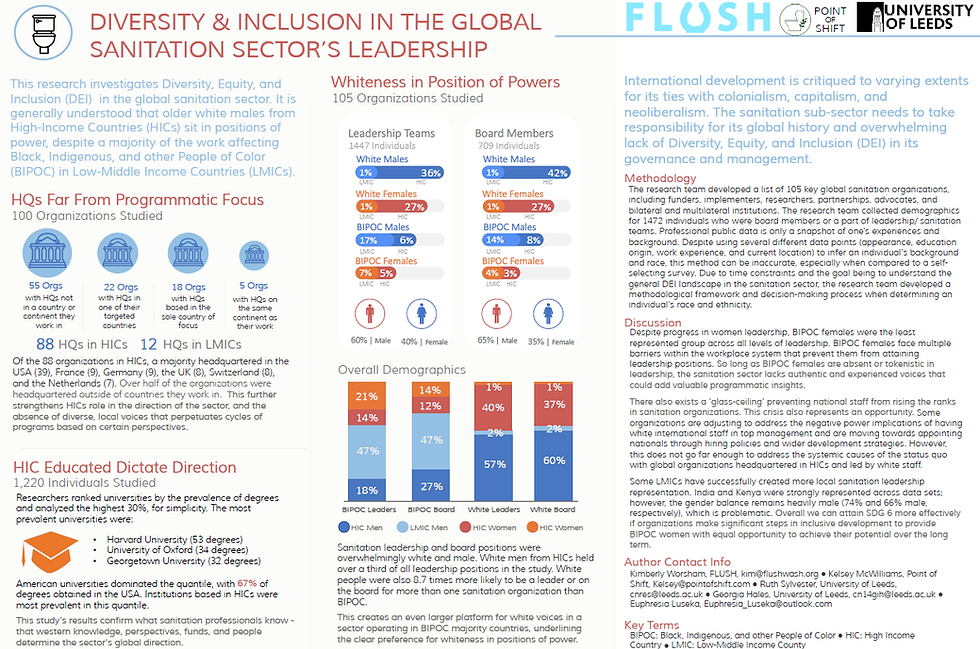
We gathered publicly available information on 1,472 individuals in leadership positions and analyzed factors such as role, gender, age range, country of origin, and education. The findings revealed that older white men from high-income countries were the most prominent group, holding over a third of all leadership positions. White leaders made up two-thirds of the sector overall. Men occupied the majority of both leadership and board roles, with the gender gap being wider at the board level than in general leadership positions. Additionally, Black, Indigenous, and other People of Color (BIPOC) women were the least represented group across all areas we examined.
One finding that stood out to us was that white individuals were 8.7 times more likely to hold leadership roles across multiple organizations simultaneously. We consistently see the same familiar faces appearing on every panel and in every boardroom, influencing critical outcomes. This trend indicates more than just a lack of diversity; it suggests that a narrow, uniform group is essentially directing the entire sector.
Where are these organizations primarily based? Most are located in the United States, the United Kingdom, and Western Europe. Very few have their headquarters in the countries where their work is actually taking place, where people live without access to safe sanitation. As a result, decisions about funding, strategy, and programs are made thousands of miles away by individuals who are often several steps removed from the communities they aim to serve.
We also found evidence of a "glass ceiling" effect, particularly affecting BIPOC women. While there is an increasing trend of hiring more national staff for in-country roles—an indication of progress—the high-salaried, high-influence positions at headquarters remain predominantly occupied by individuals from high-income countries. This situation reflects the characteristics of neo-colonial structures: strategies are formulated at the top, in the Global North, and then passed down to program country offices, often by people who have limited lived experience of the communities that these programs aim to serve.
Age played a role, too. Older leaders were more likely to be white and male. Younger cohorts showed more gender diversity, particularly among white women, but that shift hasn't translated into better representation for BIPOC women overall.
What Does it All Mean?
The leadership in the global sanitation sector does not include the voices of the people most affected by inadequate sanitation services. This issue goes beyond mere appearance—it represents a fundamental justice problem and may hinder effectiveness as well. We cannot effectively address a global challenge by continually prioritizing the perspectives of those who are least affected by it.
We want to emphasize that better data is crucial. This study revealed a significant lack of transparency regarding who holds decision-making roles in the sector. Organizations need to be more open about this, as you cannot change what you do not measure.
So What Comes Next?
That's why Euphresia's work feels so significant to us. The publication celebrating 100 African leaders in water and sanitation isn't just a feel-good list — it's an act of visibility and recognition for the leaders who are closest to the challenges, who hold deep expertise, and who have too often been overlooked in the rooms where decisions get made.
It's the kind of shift our research was calling for: not just naming the problem, but actively building a different picture of what leadership in this sector looks like.
Five years on from our study, we're hopeful because people like Euphresia will continue to change the narrative.
Read the study here: Journal article | Conference paper | Poster


